This article was translated automatically from Italian.
Property donations: what is changing (or will change)
Property donations:
what is changing (or will change) for buyers and sellers
Have you ever heard that buying a home that was once donated is risky?
It is not an urban legend: until now, anyone buying a home that had previously been the subject of a donation could risk losing it, even after many years, if an heir of the donor brought a legal claim.
However, an important reform is now under way that aims to change all this
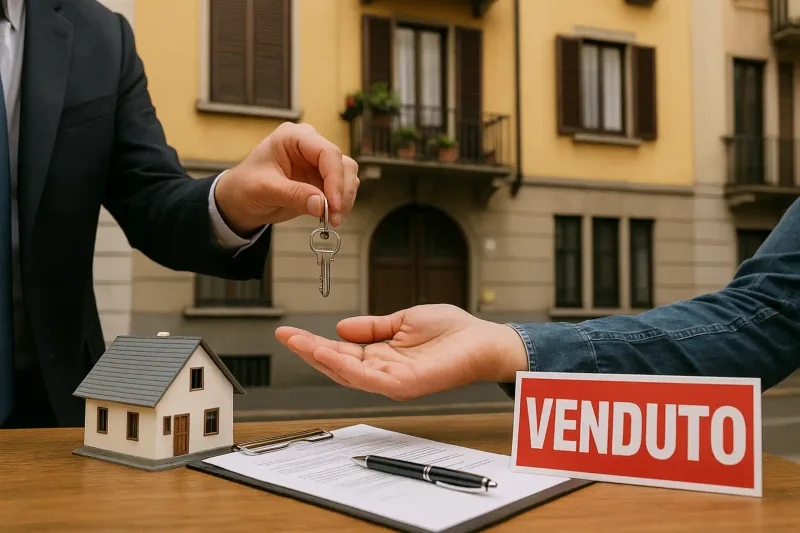
Let's look at what used to happen, what could change, and what concrete effects it would have for those buying or selling a home.
1. Before: the hidden risk behind donations
Imagine this story:
Mario gives his house to his son Luca by a deed of donation (all perfectly in order, done through a notary).
A few years later, Mario dies.
The other son, Giovanni, discovers that with that donation his brother received more than the share he was entitled to by law (the so-called “forced share”).
Giovanni brings a claim and wins: the judge rules that the donation infringed his rights.
At this point Giovanni can:
Ask Luca (the brother who received the donation) to return the property.
If Luca has in the meantime sold the house to a third party, let's say Anna, Giovanni can ask Anna to return it as well.
You understood correctly: Anna, who paid for the house and bought it in good faith, risks losing it.
This is known as the action for restitution (art. 563 of the Civil Code).
This is why many notaries, banks and estate agencies advise against buying donated properties: the legal risk is real and lasts for 20 years from the donation.
2. The consequences for the market
This rule has had a heavy impact:
Banks do not readily grant mortgages on donated properties.
Buyers ask for large discounts to take on the risk.
Those who have received a home as a donation often cannot sell it, or have to take out specific insurance policies (expensive and limited).
In practice, a property donation can freeze the economic value of an asset for years.
3. What the reform wants to change
The Government and Parliament have launched a reform of the law on succession and donations.
Some parts are already law (such as Legislative Decree 139/2024, which changes the tax rules), while others, including the one concerning the restitution of homes, are under discussion and very likely.
The aim is simple: to make donations safer and free the property market from this “bottleneck”.
In plain words:
The aim is to abolish the action for restitution against those who buy a donated property.
“Injured” heirs would no longer be entitled to seek the revocation of the donation and the recovery of the property.
At most, they would be entitled to a monetary refund from the person who received the donation (that is, the son who received it), but they could not touch the subsequent buyer.
4. A practical example: how it was and how it would be
Situation Previous rules Rules under the reform
Mario gives his house to Luca, then dies, and Giovanni (the other son) brings a claim. Giovanni can ask the judge to reduce the donation and get the house back, even if Luca has sold it to someone else. Giovanni can no longer take the house back, but can ask Luca (the brother who received the donation) for a sum of money equal to the value he is entitled to.
Anna buys the house donated to Luca. Anna risks losing the house, even after years, if the heir brings a claim and wins. Anna is protected: she no longer risks anything, the house remains hers.
The bank finances Anna to buy the house. The bank may refuse the mortgage because the house has a risky “donation” history. The bank no longer faces any risk: the house is as safe as any other property.
5. What remains to be clarified
Not everything has been decided yet.
As of today, the action for restitution is still in force, because the amendment to article 563 of the Civil Code was removed from the 2024 Budget Law.
But the reform has already been drafted in various versions and has an excellent chance of being approved in 2025, applying to donations made after it comes into force.
It remains to be defined:
whether the reform will be retroactive (that is, whether it will also apply to donations already made, which is very unlikely);
how the monetary refund owed to the injured heir will be calculated;
who will pay if the person who received the donation has no more money or assets.
6. Concrete effects on the property market
If the reform passes:
Buyers will no longer be afraid of donated homes, so sales of this type will increase.
Those who have received a donation will be able to sell without having to take out policies or perform legal acrobatics.
Banks will be more willing to grant mortgages, because the legal risk disappears.
Heirs with a forced share will still have financial protection, but will no longer be able to “dispossess” the third-party buyer.
In practice, the property market would become more fluid and secure, and the value of “donated” homes would realign with that of other properties.

In Summary
If you are given a home today, you may have trouble selling it for 20 years.
If you buy a donated home, today you still risk losing it if the donor's heirs bring a claim.
The new law aims to eliminate this risk: heirs will only be able to claim money, not the home.
The reform is concrete: some parts are already law (the tax ones), others are on their way to approval (the civil ones).
When it comes fully into force, buying or selling a donated home will finally be normal.

Alessandro Langella
Founder of Pavé, Milan
He knows Milan through years of hands-on market experience, properties visited and neighbourhoods watched as they changed.