This article was translated automatically from Italian.
Donations and property: the reform is now officially law

Donations and property: the reform is now officially law
What changes compared with what we anticipated
In recent months we analysed the possible reform of the rules on donations, in particular the amendments to articles 561 and 563 of the Civil Code. Our forecasts were based on the text approved by Parliament, but the decisive step of publication in the Gazzetta Ufficiale was still missing, the only act that makes a law truly effective.
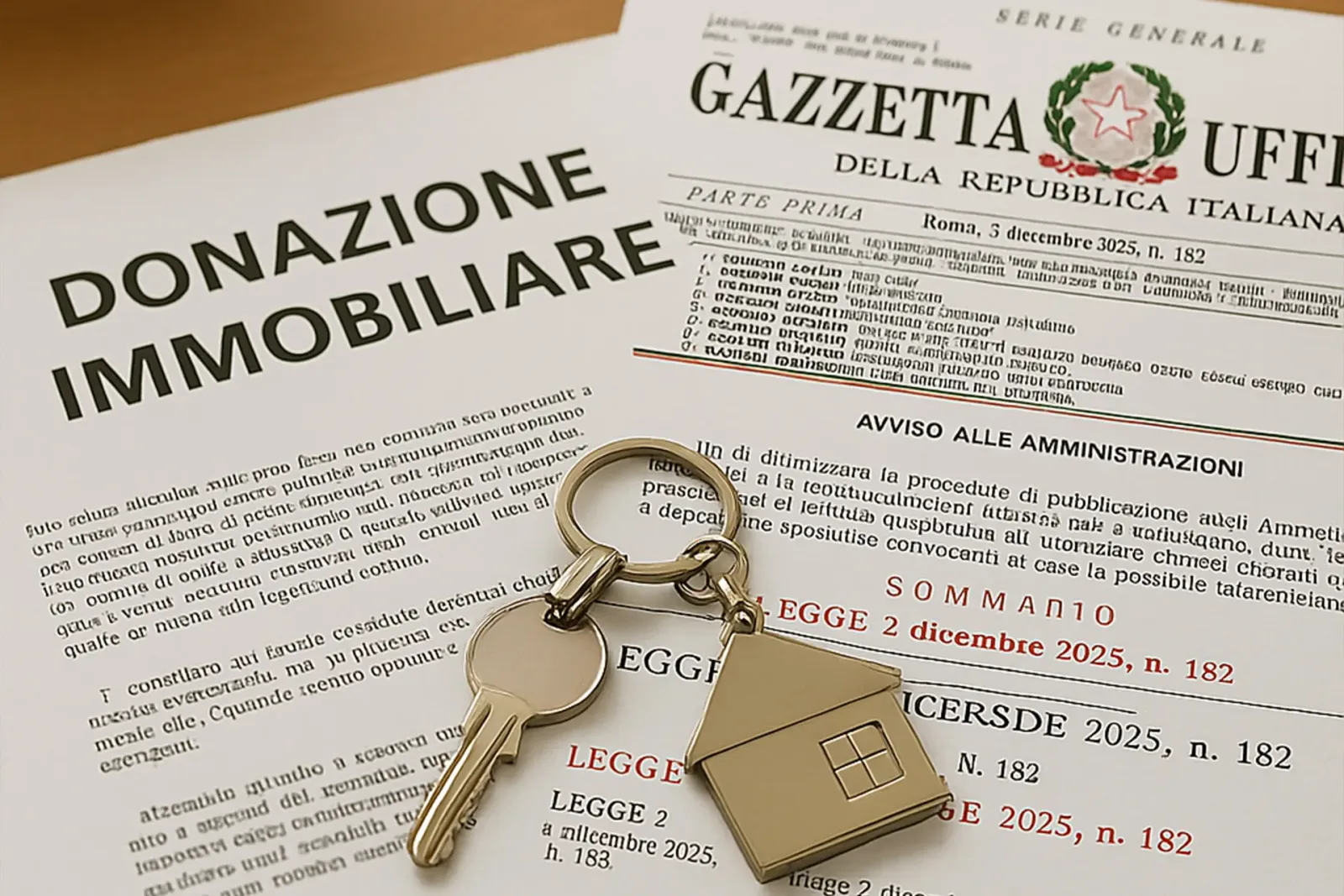
That step has now taken place. With the publication of Law No. 182 of 2 December 2025 in the Gazzetta Ufficiale of 3 December 2025, the reform has come into force. We can therefore compare our forecasts with the final framework.

What we had predicted
We had pointed to three main changes
The end of the risk of the property having to be returned by the third-party buyer
The transformation of the protection of forced heirs into a right to a monetary claim and no longer a right over the asset
Greater security in property sales deriving from donations, with a positive impact on mortgages and on the circulation of assets.
These three predictions have been confirmed in full.

What the law confirms
Now that the law has been published, these points are certain
The third-party buyer who purchases a property coming from a donation no longer risks an action for restitution, provided that the sale is registered before any action for reduction
The protection of injured heirs remains, but it takes the form of a claim against the donee, no longer a claim over the asset
Mortgages and other encumbrances registered by the donee remain valid and enforceable, ensuring stability for financing
The reform is not limited to property but concerns donated assets in general, broadening its scope of application.
In effect, the framework we had outlined proved correct in substance. The property market finally gets a clear and stable mechanism, reducing an uncertainty that for decades complicated sales and mortgages.

The differences compared with our forecasts
With publication, some points of detail in the legislation emerge that before could only be surmised
The protection of the third-party buyer depends on the correct registration of their deed before the application for reduction, a technical but fundamental detail
The amendment formally touches other articles of the Civil Code as well as the well-known 561 and 563, including 562, 2652 and 2690
The transitional regime is defined by the law and may require operational interpretation for particularly complex cases, such as very old donations or disputes already under way
These elements do not change the substance of the reform but clarify its practical application.

What it now means for buyers and sellers
With the law now in force, the situation is finally settled
Sales of properties coming from donations become secure and bankable
Banks can grant mortgages without fearing that an heir will demand the return of the asset
Buyers no longer run the risk of seeing their ownership annulled
Heirs retain the possibility of having their rights recognised, but without being able to undermine the position of the third-party buyer
The result is a more modern balance. Family protection remains, but it can no longer block the circulation of assets.

Compared
with what we had anticipated, the reform approved and now officially in force fully confirms the paradigm shift we had described. The real news is that we are no longer talking about possible scenarios, but about a law in force and already applicable.
Anyone intending to buy or sell a property of donative origin can finally count on a stable, clear and secure legal framework.


Alessandro Langella
Founder of Pavé, Milan
He knows Milan through years of hands-on market experience, properties visited and neighbourhoods watched as they changed.